

A home can feel warmer upstairs in summer, colder on winter mornings, and more expensive to cool long before there is an obvious roof leak or HVAC failure. One often-hidden reason is simple: insulation no longer covers the area at the depth it once did. Understanding why insulation settles helps homeowners address the real cause instead of adding material over contamination, moisture damage, or air leaks.
Insulation is meant to hold millions of tiny air pockets that slow heat transfer. When loose-fill material compresses, shifts, becomes wet, or is disturbed by pests, it loses thickness and may lose much of its ability to protect the home. The result can be uneven indoor temperatures, higher utility bills, more dust movement, and added strain on heating and cooling equipment.
Why Insulation Settles Over Time
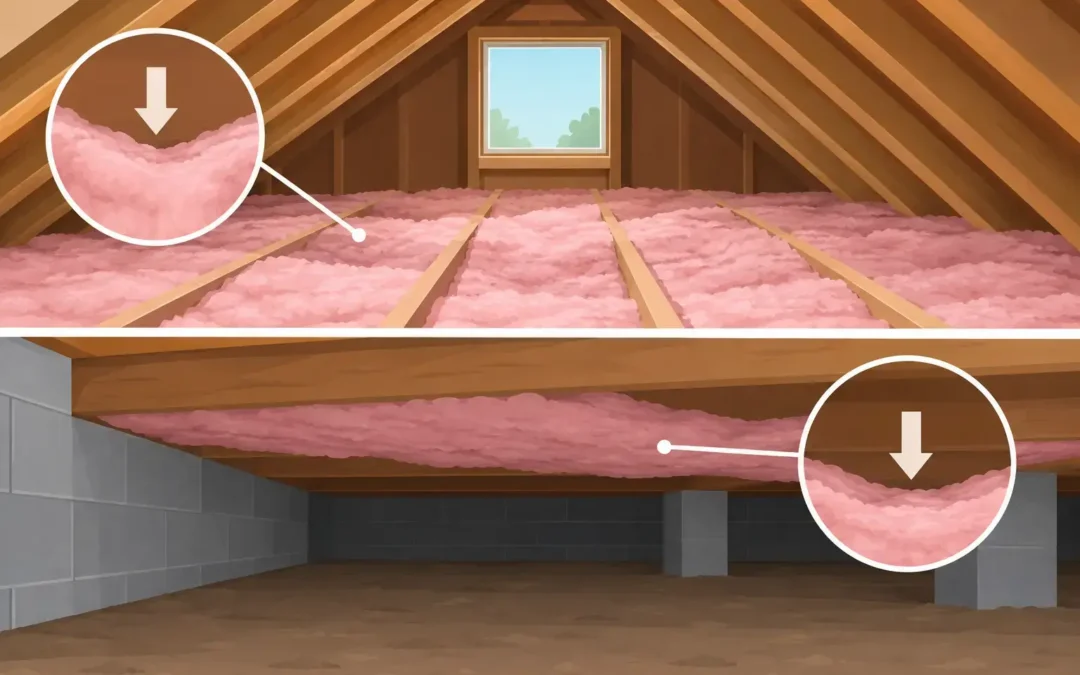
Settling is most common with loose-fill insulation, especially older cellulose or fiberglass that has been in an attic for many years. Gravity gradually compacts the material, reducing its installed depth. The insulation may still be present, but a thinner layer provides less resistance to heat flow.
Cellulose insulation can settle more noticeably than properly installed fiberglass because it is made from recycled paper fibers treated for fire and pest resistance. Installation quality matters. If cellulose was not installed at the correct initial depth to account for expected settling, its final R-value can fall below the intended level.
Loose-fill fiberglass can settle as well, although it often does so more gradually. Material installed unevenly is another common problem. Some areas may have adequate depth while others, particularly around attic access points, ductwork, recessed fixtures, and perimeter edges, are thin from the start.
Batt insulation does not usually settle in the same way, but it can slump, compress, detach, or become displaced. Batts installed without proper support may fall away from framing in walls or crawl spaces. A compressed batt also delivers less insulation value because the air pockets that make it effective have been squeezed out.
Moisture Can Turn a Small Problem Into a Larger One
Dry insulation performs very differently from wet insulation. A roof leak, plumbing leak, condensation, or crawl space moisture can cause insulation to mat down and lose depth. Water adds weight, compresses fibers, and can leave materials unable to recover even after they dry.
Moisture also creates risks beyond energy loss. Wet or persistently damp insulation can support mold growth on nearby wood framing, drywall, and paper-facing materials. In a crawl space, ground moisture can migrate upward and affect insulation, floor framing, and indoor air. Because much of the air in a home can move between lower areas and living spaces, musty crawl space conditions should not be treated as isolated problems.
In Southern California, homeowners may assume the dry climate rules out moisture damage. It does not. Wind-driven rain, aging roof penetrations, HVAC condensation, plumbing leaks, poor drainage, and coastal humidity can all introduce moisture where it does not belong. The right repair may involve insulation replacement, but it should also include finding and correcting the moisture source.
Pests Frequently Disturb and Compress Insulation
Rodents do not need to remove all the insulation to cause a serious performance issue. They tunnel through loose-fill material, build nests, carry fibers away, and leave droppings and urine behind. Over time, these pathways create thin spots that allow heat to move more freely between the attic and the home below.
Contamination changes the decision from a basic insulation top-off to a health and safety issue. Adding fresh insulation over rodent waste, dead animals, nesting material, or urine odor can trap the underlying problem and make future cleanup more difficult. It also does nothing to stop the pest entry points that allowed the infestation.
A proper remedy generally starts with rodent exclusion. Gaps around roof lines, utility penetrations, vents, and framing transitions need to be identified and sealed appropriately. Contaminated insulation can then be removed, the area cleaned and treated as needed, and new insulation installed only after the attic or crawl space is ready to remain protected.
Air Movement Can Shift Insulation and Waste Energy
Insulation works best when air leakage is controlled. It is not an air barrier. Openings around electrical boxes, plumbing penetrations, attic hatches, duct chases, and recessed lighting can allow conditioned indoor air to escape into the attic. This movement carries heat and moisture with it.
In some cases, air currents can move loose-fill insulation away from vulnerable areas. More often, air leaks make the home uncomfortable even when the insulation depth appears adequate. A homeowner may add insulation and see limited improvement because the heated or cooled air is still escaping through openings in the ceiling plane.
That is why air sealing and insulation should be evaluated together. Air sealing first helps insulation perform as intended, reduces dust and pollutant movement, and can limit condensation risks around ceiling penetrations. The correct approach depends on the home’s wiring, lighting, ductwork, ventilation design, and local code requirements.
Signs Your Insulation May Have Settled
An attic inspection can reveal the condition of loose-fill insulation quickly, but homeowners can often notice warning signs from inside the house. Rooms below the attic may heat up quickly in the afternoon, while certain bedrooms remain difficult to cool or heat. Utility costs may rise without a clear change in household use.
Other clues include visible ceiling staining, musty odors, rodent noises, drafty attic access doors, or insulation that sits below the top of ceiling joists. In a crawl space, sagging insulation, damp floor framing, fallen batts, and a persistent earthy smell deserve attention.
Depth alone is not the full story. Insulation may look thick from one area of an attic while hiding compressed sections, pest tunnels, moisture damage, or gaps around ducts and fixtures. A professional assessment looks at coverage, condition, contamination, ventilation, roof and plumbing evidence, air leakage, and the condition of ductwork before recommending a remedy.
When Adding Insulation Makes Sense and When It Does Not
If existing insulation is clean, dry, evenly distributed, and otherwise in good condition, adding material can be a cost-effective way to improve thermal performance. This is often called topping off. It can restore needed depth without requiring a complete removal project.
However, topping off is not the right answer when insulation is contaminated, mold-affected, wet, badly compacted, or heavily damaged by pests. It is also not a substitute for correcting roof leaks, condensation, duct leaks, or inadequate ventilation. Covering a problem may make the attic look better temporarily while allowing damage to continue out of sight.
Complete removal and replacement may be the better investment when the insulation has absorbed odors, contains rodent waste, has lost its structure, or prevents access to underlying repairs. During removal, a qualified contractor can inspect the attic or crawl space more thoroughly, clean affected areas, seal entry points and air leaks, and install new insulation at the appropriate depth.
Ventilation Still Matters
Insulation and ventilation serve different jobs, but both affect attic conditions. Insulation slows heat transfer between the living space and the attic. Ventilation helps manage heat and moisture in the attic itself when it is designed correctly.
An overheated attic is not always a ventilation failure, and adding more vents without evaluating intake, exhaust, roof configuration, and air leaks can create disappointing results. Powered attic fans can also be beneficial in specific situations, but they should be selected and installed with the home’s overall airflow in mind. Pulling conditioned air from the house into the attic is not a solution.
For homeowners in Los Angeles, Orange, Ventura, and Riverside counties, the most durable answer is usually a whole-system inspection. Attic heat, aging ductwork, leaky ceiling penetrations, inadequate insulation, and pest activity often overlap. Addressing only one of them may leave comfort and energy problems behind.
Protect the Home Before Replacing the Insulation
Settled insulation is a signal to inspect what happened above, below, and around it. The material may simply be old and underfilled, or it may be showing the effects of moisture, pests, air leakage, or poor installation. Those causes require different repairs.
A careful attic or crawl space evaluation can identify whether a targeted top-off, air sealing, rodent proofing, moisture correction, insulation removal, or full replacement will provide the lasting result. The goal is not just a deeper layer of insulation. It is a cleaner, drier, more comfortable home that stays protected long after the work is complete.