

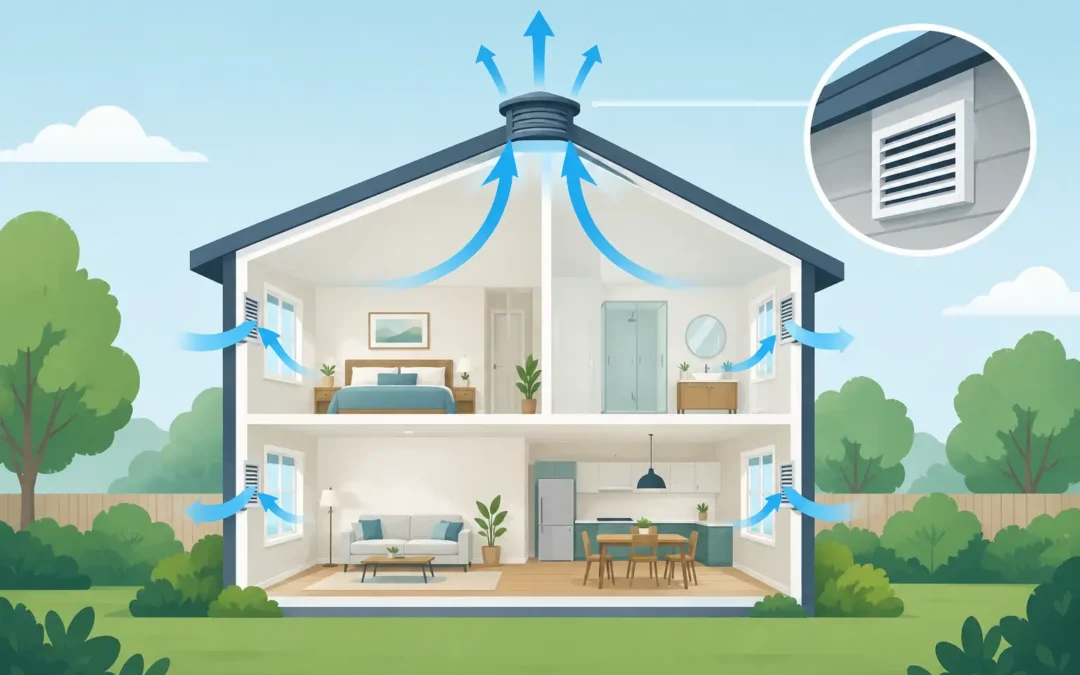
A Southern California attic can hold punishing heat long after the outdoor temperature begins to fall. When that heat has no controlled way to leave, it puts extra stress on roofing materials, insulation, ducts, and the rooms below. Proper home ventilation is not simply about making a house feel less stuffy. It is part of protecting the building from trapped heat, moisture damage, mold conditions, and unnecessary cooling costs.
For homeowners, the challenge is that ventilation problems often hide behind familiar symptoms: a second floor that never cools down, a musty crawl space, condensation on ductwork, insulation that looks matted or dirty, or unusually high utility bills. The right fix depends on where the problem begins and how the whole home is functioning.
What Home Ventilation Is Designed to Do
Ventilation moves air through designated areas of a home so heat and moisture do not become trapped where they can cause damage. In most single-family homes, the most important areas are the attic and crawl space. These spaces are outside the conditioned living area, but their condition directly affects indoor comfort, air quality, and the life of the structure.
Attic ventilation typically uses intake openings near the lower edge of the roof, such as soffit vents, and exhaust openings higher on the roof, such as ridge, roof, or gable vents. As warmer air rises and exits, replacement air enters through the lower intake points. This balanced path matters. Adding exhaust without enough intake can limit airflow, while blocked soffits can make an otherwise well-designed system perform poorly.
Crawl space ventilation is more situation-specific. Some crawl spaces benefit from properly managed venting, while others need a sealed approach with a vapor barrier, drainage corrections, and dehumidification. The best choice depends on soil moisture, water intrusion, ductwork, plumbing conditions, and local climate exposure. A damp crawl space should never be treated as a simple airflow problem without finding the source of the moisture.
Why Attic Airflow Matters in Southern California
Los Angeles, Orange, Ventura, and Riverside County homes face long cooling seasons, strong sun exposure, and major temperature swings between the attic and the living space. An attic can become far hotter than the outdoor air. That heat radiates downward and makes your air conditioner work harder, particularly when insulation is thin, compressed, contaminated, or missing in key areas.
Balanced attic ventilation helps release accumulated heat and reduce the temperature burden on the ceiling below. It can also help manage moisture that enters through ordinary household air leakage, bathroom exhaust issues, roof leaks, or condensation around ducts. Ventilation alone does not eliminate every moisture risk, but it is an important part of a complete attic system.
It also helps protect roofing materials. Excessive attic heat can contribute to premature wear, while trapped moisture can affect roof decking and framing. If moisture repeatedly reaches wood surfaces, it can create conditions favorable to staining, decay, and mold growth. A professional inspection can distinguish between a ventilation issue, a roof leak, a plumbing leak, or humidity entering from the home.
Ventilation is not a substitute for air sealing
This distinction is essential. Attic ventilation moves air through the attic. Air sealing prevents conditioned indoor air from escaping into the attic through gaps around light fixtures, plumbing penetrations, top plates, attic hatches, and duct openings.
Without air sealing, cooled air can leak out of the home while hot attic air influences the rooms below. In winter, warm indoor air can carry moisture into the attic, where it may condense on cooler surfaces. Simply installing more vents does not fix these pathways. The most effective projects usually address air leaks first, then insulation coverage, duct condition, and ventilation balance.
Signs Your Home May Need a Ventilation Evaluation
A homeowner does not need to see visible mold or roof damage before asking questions. Many ventilation and moisture problems begin quietly. Consider a professional evaluation if you notice four or more of these conditions:
- Upper rooms remain hot even when the air conditioner is running properly.
- Your attic feels excessively hot, smells stale, or has visible moisture staining.
- Bathroom fans vent into the attic instead of outdoors.
- Ductwork has condensation, loose connections, damaged insulation, or heavy dust buildup.
- Crawl space insulation is sagging, wood smells musty, or the area has standing water or damp soil.
- Rodent activity has damaged insulation or blocked vents with nesting material.
These signs do not always point to one cause. For example, a hot bedroom may be related to poor attic ventilation, but it could also result from inadequate insulation, leaky ducts, an undersized return path, or direct afternoon sun through windows. A careful inspection prevents spending money on a single improvement that does not solve the larger problem.
When Powered Attic Fans Help and When They Do Not
Powered attic fans can be useful in certain homes, especially when the attic layout makes natural airflow difficult or when heat buildup remains excessive after other issues are corrected. However, a fan is not automatically the best answer.
If an attic has major air leaks to the living space, a powerful fan may pull conditioned air from the house into the attic. That can increase cooling costs rather than reduce them. Poorly planned fans can also create pressure concerns around combustion appliances in some homes. Before recommending an attic fan, a qualified contractor should review the intake and exhaust venting, insulation, air sealing, ductwork, and any fuel-burning equipment.
The same caution applies to adding more roof vents. More openings are not always better. Different exhaust vent types can interfere with one another when installed on the same roof plane, reducing the intended airflow. Proper sizing and placement should follow the roof design, attic configuration, and applicable building requirements.
Crawl Space Ventilation Requires a Moisture Plan
A crawl space often affects the air in the home more than homeowners realize. Air can move upward through gaps in the floor system, plumbing penetrations, and return ducts. When the crawl space contains damp soil, mold growth, rodent contamination, or deteriorated insulation, those conditions can affect comfort and indoor air quality above.
In a dry, well-drained crawl space, ventilation may be part of the design. But where groundwater, plumbing leaks, poor grading, or humid outdoor air create repeated dampness, open vents may not solve the problem. Encapsulation can be a better long-term approach. This usually includes cleaning and removing contaminated materials when needed, installing a properly sealed vapor barrier, addressing water entry, sealing major gaps, and using dehumidification when conditions require it.
The goal is not to seal in a problem. It is to remove the moisture source, protect the ground and structural surfaces, and create controlled conditions that discourage mold, pests, and wood deterioration.
A Complete Approach Produces Better Results
Home ventilation works best as one part of a connected home-performance plan. During an attic or crawl space evaluation, the right questions go beyond whether vents exist. Are soffit vents blocked by insulation? Is the attic hatch sealed? Are bath fans routed outside? Is insulation adequate and free of rodent contamination? Are ducts leaking conditioned air into an extreme attic? Is there evidence of roof or plumbing leakage? Is the crawl space drawing in moisture from soil or standing water?
Addressing these conditions together protects the investment in each individual repair. Fresh insulation installed over an unsealed attic floor can underperform. A new attic fan cannot correct damaged ducts. Mold remediation will not last if water intrusion or condensation continues. Homeowners get more durable results when the underlying causes are corrected, not covered up.
The Attic Insulation Specialists Inc. evaluates ventilation alongside insulation, air sealing, ductwork, moisture control, pest damage, and contamination because these systems affect one another. That broader view is especially valuable when a home has more than one symptom.
A well-ventilated attic or crawl space should not be guessed at from the street. If your home feels hot, damp, musty, or expensive to cool, start with an inspection that looks for the source of the condition and the practical repairs needed to protect your home for years ahead.