

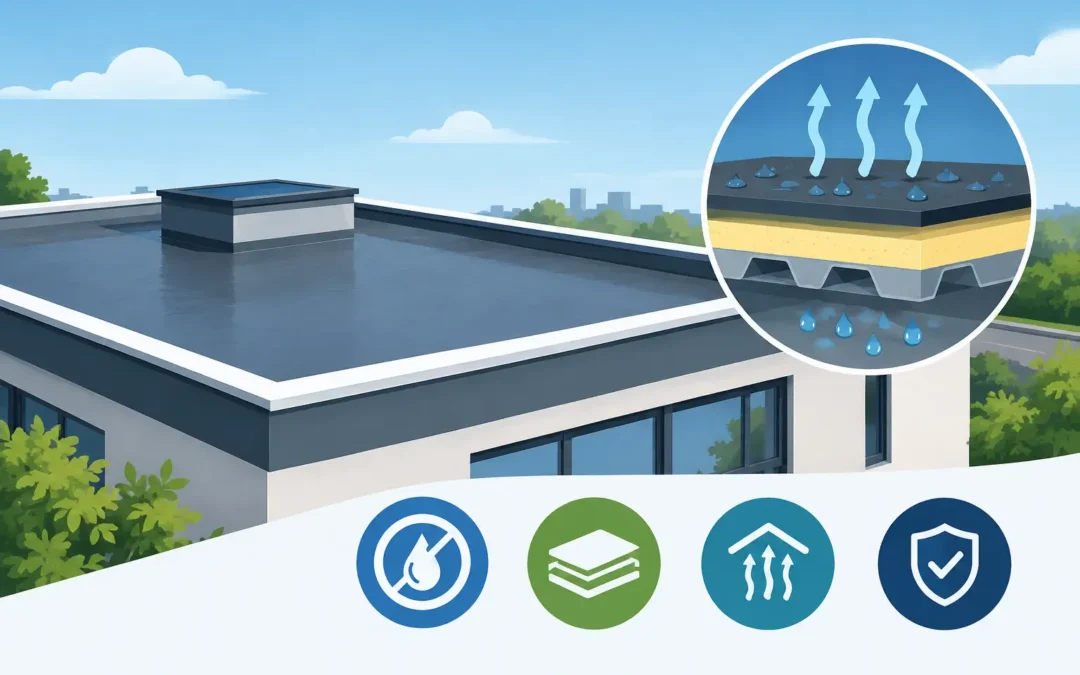
A stain on a flat-roof ceiling does not always mean rain is getting in. In many homes, moisture forms inside the roof assembly when warm, humid indoor air reaches a cold surface and turns to water. Effective flat roof condensation solutions start by identifying that hidden moisture path before damaged insulation, mold, or wood decay spreads.
A flat or low-slope roof has little room for error. Its layers must manage rainwater from above while also controlling heat, indoor air leakage, and water vapor from below. Covering a stain, adding a roof coating, or installing more insulation without diagnosing the cause can trap moisture where homeowners cannot see it.
Why Flat Roof Condensation Happens
Condensation needs three things: moisture in the air, a surface cold enough to reach the dew point, and a route for that moist air to get there. In a home, the route is often more significant than the amount of humidity.
Warm air escapes through openings around recessed lights, electrical penetrations, plumbing stacks, exhaust ducts, attic hatches, and gaps at walls. When that air reaches a cooler roof deck or metal component, it can release water. The result may be damp insulation, darkened framing, peeling ceiling paint, musty odors, or mold growth.
Southern California homes can still face condensation concerns, even without prolonged freezing weather. Coastal marine air, cool nights, seasonal rain, air-conditioned interiors, and poorly sealed ceiling penetrations can create the right conditions. A roof with inadequate insulation is especially vulnerable because the interior side of the roof deck can become cooler than expected.
Condensation may also occur when a roof was reroofed without considering the existing assembly. New roofing materials, added layers, or reflective coatings can change how the roof dries. That does not make those products wrong. It means the roof system must be evaluated as a complete assembly rather than as a surface-only repair.
Condensation or a Roof Leak? Find Out First
Condensation and roof leaks can leave similar evidence, but they require different repairs. A leak often worsens after wind-driven rain or appears near drains, flashing, seams, skylights, or roof penetrations. Condensation may be more widespread, appear during cool or humid periods, or collect around areas with air leakage.
A professional inspection should look beyond the visible stain. The goal is to inspect the roof covering, flashing, drainage, roof deck, insulation condition, ceiling penetrations, ductwork, and ventilation pathways. Moisture meters and thermal imaging may help locate wet materials or temperature differences, but they should support a physical inspection, not replace one.
It is also possible to have both problems. A minor roof leak can wet insulation, while indoor air leakage keeps that insulation damp and slows drying. Addressing only one source may leave the home exposed to recurring damage.
Warning Signs Homeowners Should Not Ignore
Call for an evaluation when you notice several of these conditions, especially after a cool spell or rain event:
- Brown ceiling rings, bubbling paint, or drywall that feels soft beneath a low-slope roof
- Musty odors, visible mold, or dark staining on framing and roof sheathing
- Wet, compressed, or rodent-contaminated insulation that no longer performs properly
- Condensation on ducts, vents, or metal components near the roofline
- Higher cooling bills, uneven room temperatures, or persistent indoor humidity
These signs do not confirm the cause on their own. They do confirm that the roof, insulation, and indoor air barrier deserve attention.
Flat Roof Condensation Solutions That Address the Cause
The right repair depends on the roof design, climate exposure, insulation location, and condition of the existing materials. A reliable plan often combines several measures rather than relying on one product.
Stop Air Leakage at the Ceiling Plane
Air sealing is one of the most effective ways to reduce condensation risk. Small openings can move far more moisture into a roof cavity than vapor diffusion through painted drywall. Sealing gaps around wiring, piping, light fixtures, top plates, duct boots, and access openings limits that airflow.
This work should be completed carefully. Fire-rated penetrations, recessed lights, and combustion equipment have clearance and safety requirements. A qualified contractor can seal the building envelope without creating a fire hazard or blocking required service access.
Correct Insulation Coverage and Placement
Insulation keeps interior surfaces warmer, reducing the chance that humid indoor air will meet a cold roof deck. But the type, thickness, and location matter. Insulation that is wet, compressed, contaminated by rodents, or poorly installed cannot provide its rated performance.
For some flat-roof assemblies, insulation is installed above the roof deck during reroofing. This can keep the deck warmer and reduce condensation potential. In other assemblies, insulation may be installed below the deck or within a framed cavity. Each approach has trade-offs involving cost, roof height, drainage details, drying ability, and local code requirements.
Simply packing more insulation into an enclosed cavity is not always the answer. If air leakage and vapor control are unresolved, additional insulation can hide a moisture problem until wood damage becomes severe.
Use the Correct Vapor Control Layer
A vapor retarder or vapor barrier controls water vapor movement through materials. The correct product and placement depend on the roof assembly and local conditions. Installing an impermeable layer on the wrong side of the insulation can prevent a roof from drying in the direction it needs to dry.
This is why one-size-fits-all advice is risky. A roof that performs well in a cold northern climate may need a different approach in Los Angeles, Orange, Ventura, or Riverside County. Existing roofing layers, interior humidity levels, and the presence of air conditioning all affect the design decision.
Repair Roof Defects and Improve Drainage
No condensation strategy can compensate for an actively leaking roof. Damaged membranes, failed seams, cracked flashing, clogged drains, ponding water, and poorly sealed penetrations must be corrected first. Water entering from above can mimic condensation and saturate insulation quickly.
Drainage matters on low-slope roofs because standing water shortens the service life of many roof coverings and increases the consequences of small defects. A roofing professional may recommend repairs to drains, scuppers, slopes, flashing, or the roof membrane itself. Those repairs should coordinate with the insulation and moisture-control plan below the roof.
Address Ductwork and Indoor Humidity
Leaky or uninsulated HVAC ducts near the roofline can create cold surfaces and introduce humid air into hidden cavities. Bathroom exhaust fans that terminate in an attic or roof cavity are another common source of moisture. Exhaust air must be routed outdoors through properly installed ducting, not released into the building envelope.
Indoor humidity should be reviewed as part of the diagnosis. Cooking, showers, aquariums, frequent window opening during humid weather, and oversized or poorly operating HVAC equipment can all contribute. A dehumidifier may help in certain situations, but it is not a substitute for repairing leaks, sealing air paths, or correcting a flawed roof assembly.
When Mold or Wet Insulation Is Already Present
Wet insulation should not be treated as a minor inconvenience. It loses thermal performance, can hold moisture against framing, and may become contaminated by mold or pests. If the material is extensively wet, moldy, or rodent-affected, removal and replacement may be safer than attempting to dry it in place.
Mold remediation should address the moisture source before surfaces are cleaned or sealed. Otherwise, the visible growth may return. Damaged drywall, sheathing, or framing may also need repair depending on the extent of deterioration.
The Attic Insulation Specialists Inc. approaches these problems as connected home-performance issues. Insulation, air sealing, ventilation, contaminated-material removal, ductwork condition, and moisture control should be evaluated together so homeowners are not paying for isolated repairs that leave the original cause behind.
Avoid These Shortcuts
Roof coatings can be useful for the right roof, but they are not automatic condensation solutions. Likewise, adding a powered fan without understanding the roof design can pull conditioned air from the home into the roof cavity, increasing energy loss and moisture movement.
Do not cover mold-stained materials, install new insulation over wet insulation, or assume every ceiling stain is a roofing issue. These shortcuts can delay proper repairs while moisture continues affecting the structure and indoor air.
A careful inspection gives you a clearer path forward: repair exterior water entry, control indoor air leakage, restore insulation performance, and use vapor and ventilation measures that fit the actual roof assembly. That is how a flat roof stays dry, efficient, and better prepared to protect the home beneath it.